In the field of fast-food packaging, users often first focus on the capacity and external dimensions of paper bowls. However, the key factors that truly influence user experience lie in material selection, structural design, and production processes. Many users tend to overlook how these underlying elements critically determine performance in aspects such as leak resistance, thermal insulation, and grip comfort.
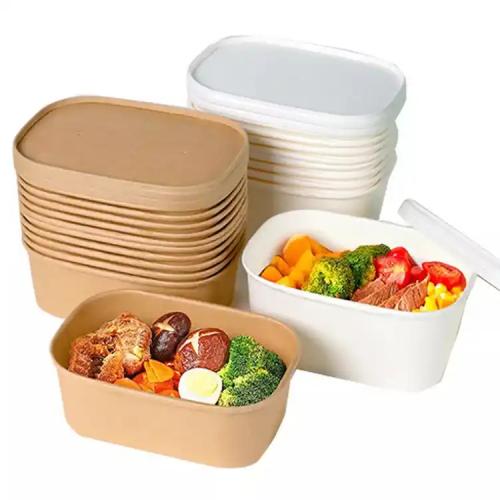
Working Principle and Core Structure Analysis
The use of virgin bamboo pulp provides superior fiber toughness compared to ordinary wood pulp. These natural long fibers form a denser network structure during hot-press molding. The double-layer wall design of the bowl is not merely about increasing thickness but achieves thermal insulation and cushioning through an intermediate air layer. The tapered design, with an upper opening diameter of 14.3 cm and a bottom diameter of 10.4 cm, considers both the economic efficiency of stacking and transportation and the fluid dynamics stability when pouring liquids. The circular contour, combined with a height of 10.2 cm, forms an optimal center of gravity distribution.
How Technical Differences Impact Practical Applications
The bamboo pulp content directly affects oil resistance—tighter fiber arrangement results in longer anti-seepage duration. Variations in rim curling processes (single-layer vs. multi-layer composite) among manufacturers lead to edge strength differences of up to 40%. In tests involving continuous loading of 95°C hot soup, the deformation rate of the double-layer wall structure is 60% lower than that of single-layer designs, though this increases raw material consumption by approximately 15%. These technical choices ultimately manifest in the actual performance when holding contents of different temperatures and viscosities.
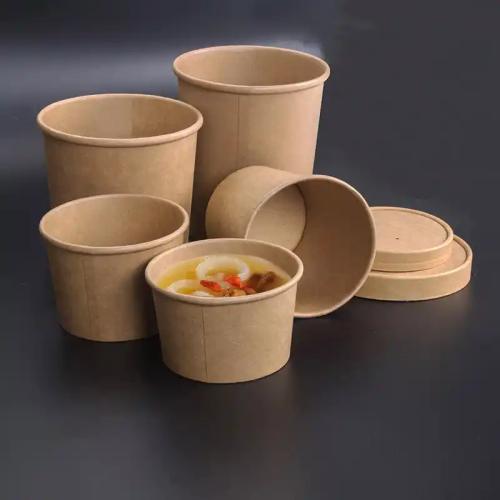
Application Scenarios and Evaluation Framework
Evaluation should focus on three key dimensions: for high-temperature scenarios, assess the PE coating coverage at the bowl bottom seam; for high-fat foods, check the uniformity of internal adhesive application; for transportation, consider the stacking stability enabled by the tapered design. For takeout scenarios requiring prolonged thermal insulation, the integrity of the air gap is more effective than simply increasing wall thickness. Meanwhile, high-frequency-use food service businesses should pay attention to how the curling process impacts manual sorting efficiency.
(Repeated for emphasis: Application scenarios and evaluation framework should focus on three dimensions: high-temperature scenarios (assess PE coating coverage at the bowl bottom seam), high-fat foods (check internal adhesive uniformity), and transportation (consider tapered design for stacking stability). For long-term thermal insulation in takeout, the air gap’s integrity outperforms mere wall thickening. High-frequency-use businesses should also monitor the curling process’s effect on sorting efficiency.)